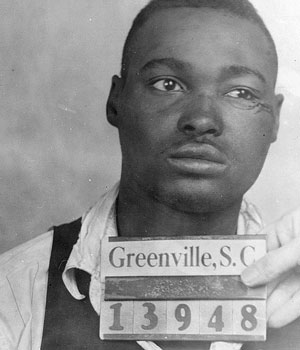
 64 years ago, the last lynching in South Carolina took place about 10-15 miles from where I live. And next week, after a very long 64 years, there will finally be a memorial on the rural back road where it happened.
 [Trigger Warning]
On February 16, 1947, Thomas Watson Brown, a white cab driver, picked up a black man on Markley Street in Greenville, South Carolina. Brown was later found half-dead, his taxi driven off the road in rural Pickens County. He had been beaten, robbed, and stabbed three times.
The Pickens County sheriff reported that muddy footprints at the crime scene led to the house of Willie Earle, about a mile away, where officers reportedly found cash, a blood-covered knife and bloody clothing. (Many of these facts have always been in dispute, but this is what was presented at trial.) Willie Earle, age 24, wasn't at his residence; he was in another cab, driven by a man who would later become one of the 31 defendants.
Earle was arrested and put in the Pickens County second-floor lock-up.
The news of Brown's stabbing traveled like wildfire, as did the news of Willie Earle's arrest. The nexus of unrest was the Yellow Cab office on West Court Street, where Greenville's taxi drivers had congregated in an angry pack, and started passing around a bottle of whiskey.
The Greenville News, recently granted access to some of the trial records and police reports, offers some chilling accounts:
The attitudes of the time are reflected in the casual manner in which one of the defendants, Hubert Carter, explained in his statement to police how he joined the mob.And so, in a tableau reminiscent of the famous scene in To Kill A Mockingbird (and perhaps it was an inspiration for it), the taxis all lined up in the early morning hours and drove in formation out to the Pickens County jail, maybe 20 miles away. It was February 17th.
The 33-year-old driver and father of four called for a ride home from the Cleveland Street taxi stand at 1 a.m. on the 17th, according to the Greenville Police Department file. He was picked up by another defendant, Paul Griggs, who "asked me if I wanted to go with the others to get the Negro being held for stabbing Mr. Brown.
"I told him I'd go along with the crowd," Carter said in his statement.
I have often re-imagined the striking sight of the line of yellow cabs driving down the old rural road I have traveled down so many times myself. Did other people see them? They must have. Did the onlookers know where they were going? Did they tell their wives or girlfriends first?
And there was, sadly, no Atticus Finch to stand by the door. Instead, there was a jailer named Gilstrap, who suddenly had two shotguns pointed in his face. He didn't argue.
The mob took Willie Earle from the jail.
A call to Greenville's black funeral home, notified authorities of where the body was.
Thomas Brown died six hours later.
~*~
The first lynching since 1912, the murder of Willie Earle became big news. The trial was biggest lynching trial the state had ever seen. Most lynchings had never even been investigated, while this one had then-Governor Strom Thurmond threatening to put the perpetrators away (yes, you read that right). Time magazine sent reporters, and The New Yorker sent no less than Dame Rebecca West to cover the event.
From Time magazine:
Somebody "pulled the Negro out of the car by his belt." The drivers ''hit him several times with their fists and knocked him to the ground." One of the drivers pulled out a knife. "Before you kill him," he said, "I want to put the same scars on him that he put on Brown." Said Jessie Lee Sammons: "I could hear the tearing of clothing and flesh."Of course, it was an all-white jury. Of course, they offered no defense at all. And of course, they were acquitted.
Then the drivers "beat the side of his head with a shotgun." Said Marvin H. Flemming's statement: "I could hear some licks like they were pounding on him with the butt end of a gun. I heard the Negro say, 'Lord, you done killed me.' " Finally, said Charlie Covington, he heard Roosevelt Carlos Hurd Sr., a Blue Bird cab driver, cry out: "Give me the gun and let's get this over with." Just then, "a tall, slender boy with bushy hair hit the Negro in the mouth and knocked him down. The Negro started to get up when Mr. Hurd took the shotgun. He shot the Negro in the head. He unloaded the gun and called for more shells. . . . Mr. Hurd shot the Negro two more times." The tissue of Willie Earle's brain was left hanging on the bushes. The lynchers went back to Greenville and drank coffee.
Of the acquittal, Dame Rebecca West wrote:
There could be no more pathetic scene than these taxi-drivers and their wives, the deprived children of difficult history, who were rejoicing at a salvation that was actually a deliverance to danger. For an hour or two, the trial had built up in them that sense of law which is as necessary to man as bread and water and a roof. They had known killing for what it is: a hideousness that begets hideousness. They had seen that the most generous impulse, not subjected to the law, may engender a shameful deed. For indeed they were sick at heart when what had happened at the slaughter-pen was described in open court. But they had been saved from the electric chair and from prison by men who had conducted their defense without taking a minute off to state or imply that even if a man is a murderer one must not murder him and that murder is foul. These people had been plunged back into chaos.Chaos is the word. Chaos was the state of race relations in the south until the Civil Rights movement, when the chaos was at last addressed.
Next week, after many long decades, the spot where Willie Earle was murdered will be officially and historically marked. Future generations will not be like me, driving by a rural place in the road without knowing whose blood was shed there. We will see, and we will know.
Tessie Robinson, Willie's mama, died 8 years ago. I am so sad she will never see the memorial to her son.
For black people, a memorial and a reminder of what they already know and do not have to be told. For us white people, a souvenir of our savagery, and the cover-up of that savagery. Which is why the memorial has taken 64 years.
Rest in Peace, Willie Earle.
~*~
crossposted at Womanist Musings.


